
"PHILOLOGY IN THE WORLD OF DIGITAL TRANSFORMATIONS"
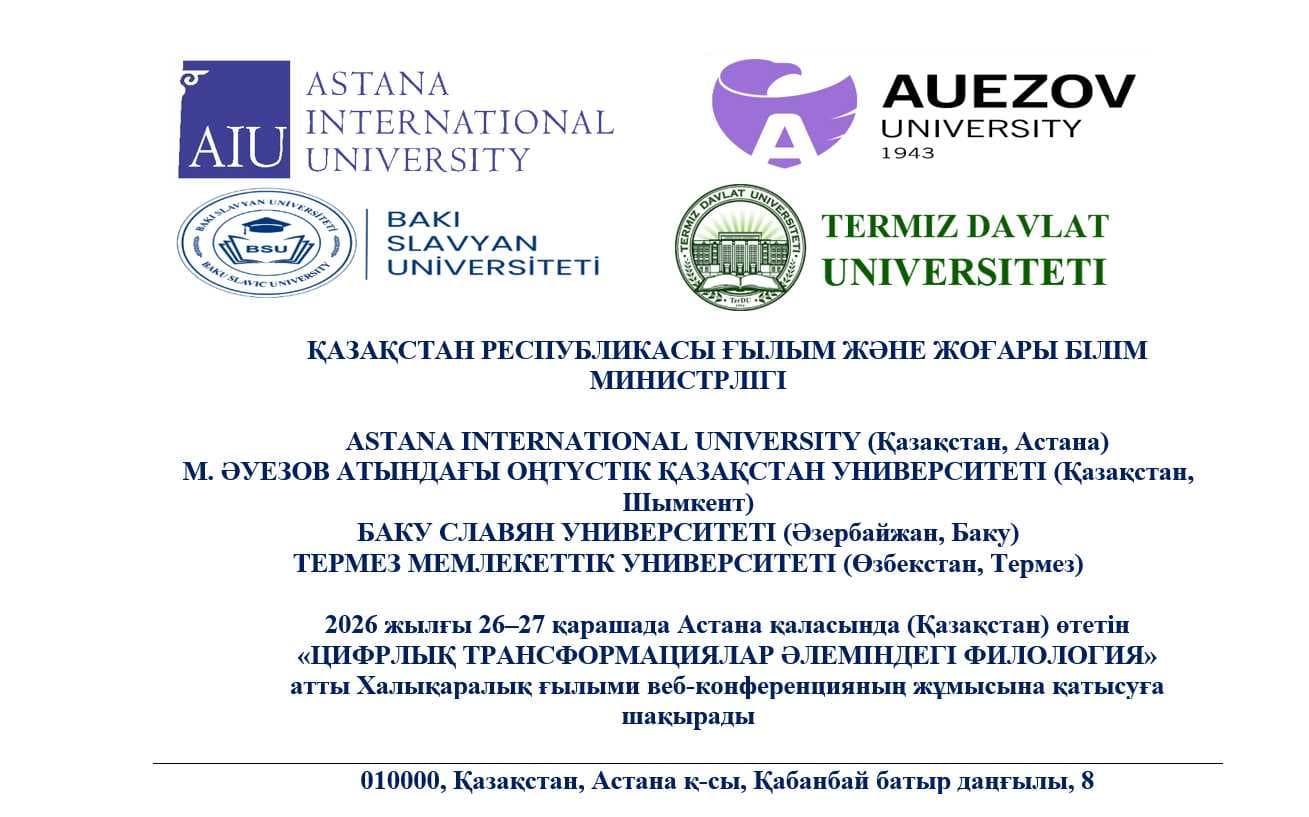
MINISTRY OF SCIENCE AND HIGHER EDUCATION OF THE REPUBLIC OF KAZAKHSTAN
ASTANA INTERNATIONAL UNIVERSITY (Astana, Kazakhstan)
M. AUEZOV SOUTH KAZAKHSTAN UNIVERSITY (Shymkent, Kazakhstan)
BAKU SLAVIC UNIVERSITY (Baku, Azerbaijan)
TERMEZ STATE UNIVERSITY (Termez, Uzbekistan)
invite you to participate in the
International Scientific Web Conference
"PHILOLOGY IN THE WORLD OF DIGITAL TRANSFORMATIONS"
to be held on 26–27 November 2026 in Astana, Republic of Kazakhstan
8 Kabanbay Batyr Avenue, Astana 010000, Republic of Kazakhstan
INFORMATION LETTER
Dear Colleagues!
We invite school principals and teachers, educational methodologists, faculty members of colleges and higher education institutions, undergraduate, master's and doctoral students to participate in the International Web Conference "PHILOLOGY IN THE WORLD OF DIGITAL TRANSFORMATIONS."
The purpose of the conference is to establish an international academic platform for discussing current trends and future prospects for the development of philology in the digital era, as well as to exchange research findings and practical experience in linguistics, literary studies, language education, and the application of innovative technologies in the humanities.
The main conference topics are:
1. Functioning of Turkic Languages in the Digital Environment: Education and Communication.
2. Artificial Intelligence and Digital Technologies in Philological Research and Teaching.
3. Digital Educational Resources in Foreign Language Teaching at Higher Education Institutions.
4. Teachers and Modern Educational Multimedia Resources.
As part of the conference, participants' workshops entitled "Philology Online: New Guidelines for Innovative Practice" will be organized in the following areas:
1. Teachers and Modern Educational Multimedia Resources.
2. Transformation of Reading: New Forms of Literature in the Digital Environment.
3. Digital Linguistics: Studying Language Transformation in the Digital Environment.
The conference will be held in a hybrid format using distance-learning technologies.
Links for online participation will be sent together with the Conference Programme on 23 November 2026.
Working languages of the conference: Kazakh, Russian and English.
Following the conference, an electronic volume of conference proceedings will be published. The originality of the paper must be at least 70%. Participation in the conference and publication of papers in the electronic proceedings are free of charge.
All required materials should be submitted to the Organizing Committee in one e-mail by 20 November 2026 (inclusive). File names should be formatted as follows: Surname_Registration Form, Surname_Paper or Surname_Video
The electronic conference proceedings will be available for download from 20 December 2026 on the website of Astana International University:
https://www.aiu.kz/ru/science/conf .
Registration form (issued in the language of publication)
|
Full name of the author (specify in full) |
|
|
Place of work |
|
|
Academic degree/title |
|
|
Position |
|
|
Contact phone number |
|
|
E-mail (valid) |
|
|
Title of the conference section / Master class in video format |
|
|
Article title/ The name of the video |
|
|
Form of participation (face-to-face/remotely) |
|
Requirements for the design of materials for publication
The text of the article is in doc format (Microsoft Word 2003-2007). A4 sheet size (297x 210 mm). Page format: all margins are 2 cm, pages are not numbered. Font: Times New Roman, size – 14 pt, for annotations, keywords and references – 12 pt. The text should be formatted in width without hyphenation, paragraph indentation – 1.0 cm. The line spacing is single. The volume is 5-7 pages.
The title of the article is centered (14 pt, capital letters, bold). Indented to the right are the last name and initials of the author(s) (12 pt, plain font, bold), place of work, country, city, e-mail (12 pt, non-bold, plain font). On the next line, an abstract (no more than 100 words) and keywords (no more than 7 words) are formed in the language of publication and in English (12 pt, non-bold, italics). The quotation marks are arranged in the form of a Christmas tree («»). The examples given are highlighted in italics. A numbered list of used information sources at the end of the article, (12 pt) in the order of references. The source number and page are indicated in square brackets [1:17].
General requirements and rules for the compilation of tables and graphic materials:
- formatting tables. Each table should be numbered and have a heading. The table number and title are placed above the table on the left edge. The number is formatted as "Table 1" ("Кесте 1", "Таблица 1"), the font style is italics. The table header is separated by a dash;
- design of graphic materials. Graphic materials should be prepared using Microsoft Graph or Excel programs without using scanning. Graphic objects should be in the form of a drawing or grouped objects. Graphic objects should not extend beyond the margins of the page or exceed one page.;
- each object must be numbered and have a title. The item number and title are placed under the item on the left edge. The number is formatted as "Figure 1" ("Сурет 1", "Рисунок 1");
- formalization of formulas. Mathematical formulas are generated through the formula editor "Microsoft Equation". Their numbering is indicated on the right side in parentheses. If there are a large number of formulas, we recommend that they be numbered independently for each section.
Rules for making a list of cited literature:
Books by the same author:
Galichkina E.N. Computer communication: linguistic status, sign means, genre space: monograph. – Volgograd: Paradigma, 2012. – 322 p.
Books by two or three authors:
Nurtazina M.B., Kadeeva M.I. Functional principles of language description for applied purposes: a reference guide to the modern Russian language. – Astana: L.N. Gumilyov Eurasian National University, 2015. – 236 p.
Article from the conference collection:
Aubakirova Zh.S., Shakarim S.B., Zhanybekova B.N. Gaming and interactive tools in teaching Russian language and literature // Collection of materials of the international scientific and practical conference "AIU – 2026: Artificial intelligence and digital transformation as a vector of development of science of young scientists". - Astana: Astana International University, 2026. – P. 580-584.
Article from the magazine:
Shakhmetova N.A., Smailova Zh.A. Intermediality in Students' Written Work: A Study of the Auxiliary Potential of Generative Intelligence // TOU Bulletin. Pedagogical Series. - 2025. - No. 4. - Pp. 202-219.
Voiskounsky A.E. Internet Metaphors // Questions of Philosophy. - 2001. - No. 11. - Pp. 64-79.
Internet sources:
Bakhtin M.M. The works of François Rabelais and the popular culture of the Middle Ages and the Renaissance. - 2nd ed. - M.: Art. lit., 2000. - 543 p. // [Electronic resource] Access mode: http://www.philosophy.ruibrary/bahtin/rable.html.
Translated editions:
Bloomfield, L. Language / L. Bloomfield; lane from English E. S. Kubryakova and V. P. Murat. – M.: Progress, 1968. – 607 p.
The Organizing Committee reserves the right to select articles for publication. Upon receipt of materials, the Organizing Committee will send a confirmation of receipt to the author within 3 business days. Articles are not reviewed or returned. Authors are responsible for the content of submitted articles and any forms of plagiarism. Materials are published in the original version.
Sample article format
TEXT AS A DIDACTIC UNIT
Bekturova Zh.B.1, Kadeeva M.I.2
1Astana International University, Kazakhstan, Astana,
2Kazakhstan South Kazakhstan Pedagogical University
named after Ozbek Zhenibekov, Kazakhstan, Shymkent
е-mail: bekturova.z@mail.ru, kadmi_ordabasi@mail.ru
Статья посвящена исследованию лингво-исторического поля языковых единиц, функционирующих в баснях И.А. Крылова. Предметом рассмотрения выступает процесс работы над проектом (предмет «Русская литература»), примененного при изучении раздела «Сатира и юмор в литературе. Поучительный жанр басни». Актуальным при этом для учителя и ученика становится понимание исследовательской деятельности как инструмента повышения качества образования.
Ключевые слова: художественный текст, проектно-исследовательская деятельность, школьное образование, развивающее обучение.
The article is devoted to the study of the linguistic and historical field of linguistic units functioning in the fables of I.A. Krylov. The subject of the review is the process of working on a project (the subject "Russian literature") used in the study of the section «Satire and humor in literature. The instructive genre of the fable». At the same time, the understanding of research activity as a tool for improving the quality of education becomes relevant for teachers and students.
Keywords: artistic text, design and research activities, school education, developmental learning.
Text text text text text text text text [1: 23]. Text text text text text text text text text text text text text [2]. Text text text text text text text text text in Fig. 1. Text text text text text in Table 1.
List of references:
1. Kupina, N.A. Linguistic Analysis of the Fiction Text. Moscow: Flinta: Nauka, 2003, 124 p.
2. Babenko, L.G., Kazarin, Yu.V. Linguistic Analysis of the Fiction Text: Theory and Practice. Moscow: Flinta, Nauka, 2003, 112 p.
Share: